

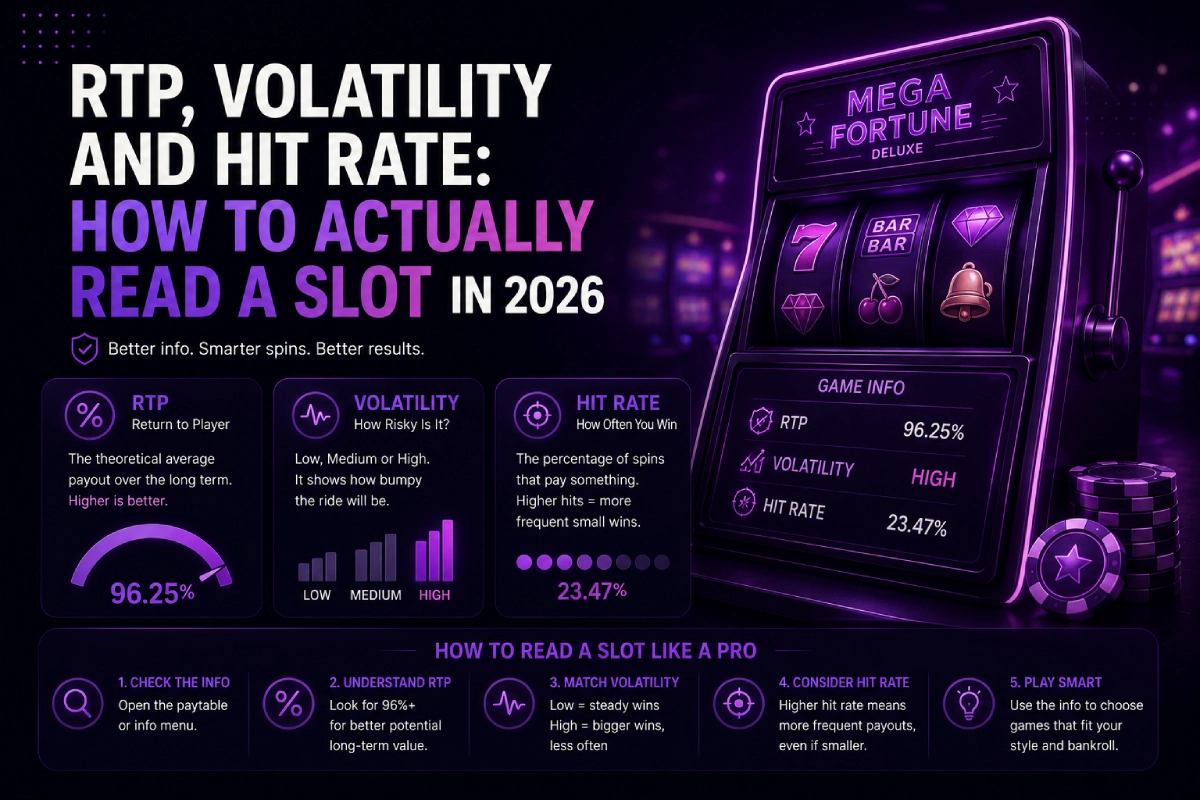
Every slot in 2026 comes with a spec sheet, tucked away in the info panel, that tells you far more about how it will treat your bankroll than the flashing lights ever will. Three numbers matter most: RTP, volatility and hit rate. Learn to read them and you'll pick games that match how you actually like to play, instead of being surprised when a slot eats your balance in ten minutes or bores you with tiny wins. None of them will make you a winner, but together they tell you what kind of ride you're buying.
The catch is that these three are often confused with one another, and a lot of players fixate on the one that matters least for a single session. Let's take them one at a time, in plain English.
RTP: the long-run price of playing
RTP, return to player, is the percentage of all money wagered that a slot pays back over an enormous number of spins. A 96% RTP means that, across millions of spins from everyone playing, the game returns £96 for every £100 staked and keeps £4 as the house edge. Higher is better for you, and most mainstream slots sit somewhere in the mid-90s.
The crucial word is "long-run." RTP is a statistical average over vast numbers of spins, not a promise about your session. You will not get 96% of your money back on an afternoon's play; you might double up, or lose the lot. RTP tells you the built-in cost over time, nothing about tonight. It's the single most reliable comparison between two similar games, but a poor predictor of any one visit.
Volatility: how bumpy the ride is
Volatility, sometimes called variance, describes how a slot pays, not how much it returns overall. Two slots can share the same 96% RTP and feel completely different. A low-volatility slot pays small amounts frequently, so your balance drifts up and down gently and your money lasts. A high-volatility slot pays rarely but can pay big, so you'll sit through long dry spells hoping to hit a feature that makes up for them in one go.
This is the number that most shapes a session, and the one players underrate. High volatility is thrilling and can deliver the eye-watering wins you see clipped online, but it chews through a small bankroll fast and punishes short sessions. Low volatility is steadier and stretches your money, at the cost of rarely producing a memorable win. Neither is "better"; they suit different budgets and temperaments.
Hit rate: how often anything happens
Hit rate (or hit frequency) is the percentage of spins that return any win at all, even one below your stake. A 25% hit rate means roughly one in four spins pays something. It's related to volatility but not identical: a slot can have a decent hit rate made up almost entirely of tiny wins, which feels busy but slowly bleeds your balance, since a "win" smaller than your bet is still a net loss on that spin.
Hit rate is really about the texture of play, how alive the game feels spin to spin, rather than whether you profit. Don't mistake a high hit rate for a generous slot. Frequent small returns can mask steady losses just as easily as they can keep a session ticking along. Read it alongside volatility, never on its own.
A worked example
Imagine three slots, all with an identical 96% RTP, and how a £100 bankroll at £1 a spin might feel on each. Same long-run cost, three very different afternoons.
| Slot | RTP | Volatility | Hit rate | How the session feels |
|---|---|---|---|---|
| Steady Eddie | 96% | Low | ~30% | Frequent small wins, balance drifts slowly, long play time, rarely a big hit |
| Middle Ground | 96% | Medium | ~22% | A mix of small wins and occasional decent features, balanced swings |
| Big Swing | 96% | High | ~18% | Long dry spells, then a rare large hit; a small bankroll can vanish quickly |
Same RTP, wildly different experiences. If you've got £100 and want an hour of entertainment, Steady Eddie is your friend. If you've got a small stake you're happy to lose chasing one big feature, Big Swing is built for that, just don't expect it to last. Matching volatility to your bankroll and your patience is the single most practical thing this article can teach you.
Where to check the numbers
RTP is almost always in the game's info or paytable screen, usually one tap from the main view, and at licensed casinos it has to be disclosed. Be aware that some games ship in multiple RTP versions, and an operator can deploy a lower one, so it's worth confirming the figure in the game you're actually loading rather than trusting a number you saw elsewhere.
Volatility is often stated by the provider as low, medium or high, sometimes on a scale out of five. Hit rate is published less consistently; when it's missing, the provider's volatility rating and a few minutes in demo mode will tell you most of what you need. Reputable review sites and the studios themselves are the reliable sources. For how we apply these checks across a whole library, our UK online slots guide walks through the same method on real games.
How we use these numbers
When we assess a casino's slot library, we check that RTP is disclosed in-game and hasn't been quietly set to a lower version, and we describe volatility honestly so you know whether a game suits a careful bankroll or a thrill-seeking one. We won't tell you a slot is "due" a win, because no slot ever is, each spin is independent. What we can do is help you pick games whose maths match how you want to play, which is the only edge a slot player realistically gets.
The honest bottom line
Reading RTP, volatility and hit rate makes you a smarter, better-informed player, but it doesn't change the fundamental deal: every slot is built with a house edge, and over time it wins. These numbers help you choose a game that fits your budget and lasts as long as you want it to; they can't turn a losing proposition into a winning one. Use them to buy the entertainment you actually want, set a limit before you spin, and treat any win as a nice surprise rather than the plan.
FAQ
Does a high RTP mean I'll win more?
Not in any single session. RTP is a long-run average over millions of spins, so a higher figure means a lower built-in cost over time, but it says nothing about tonight. You can lose on a 97% slot and win on a 94% one on any given day. Over the very long run, higher RTP is better; over one visit, it's close to irrelevant.
What's the difference between RTP and volatility?
RTP is how much a slot pays back overall; volatility is how it pays. Two slots can share the same RTP yet feel totally different, one dribbling out frequent small wins, the other paying rarely but big. RTP is the long-run price; volatility is the shape of the ride you'll actually experience.
Is a high hit rate a good sign?
Not on its own. Hit rate is just how often a spin returns anything, and many of those "wins" can be smaller than your stake, which is still a net loss. A busy-feeling slot with a high hit rate can bleed your balance as surely as a quiet one. Always read hit rate alongside volatility and RTP.
How do I match volatility to my bankroll?
As a rule of thumb, a smaller bankroll or a wish for longer play points to lower volatility, which spreads frequent small wins and stretches your money. A stake you're happy to risk chasing one big hit suits higher volatility, but expect long dry spells and be ready to lose it quickly. Match the game to your budget and your patience.
Where do I find a slot's RTP and volatility?
RTP is in the game's info or paytable screen and must be disclosed at licensed casinos, though some games ship in multiple RTP versions, so confirm it in the game you're actually loading. Volatility is usually stated by the provider as low, medium or high. When hit rate isn't published, a few minutes in demo mode fills the gap.
Can knowing these numbers make me a winning player?
No. Every slot carries a house edge and wins over time, and no spin is ever "due." What these numbers can do is help you choose a game that fits your budget and lasts as long as you want, so you get the entertainment you're paying for. That's the only realistic edge, understanding what you're buying, not beating the maths.
Play responsibly
Gambling should be fun, never a way to make money or chase losses. Understanding a slot's maths won't change its house edge, so set a deposit and time limit before you play and use the cooling-off tools and self-exclusion every licensed casino provides, or read our responsible gambling guide. 18+ only.