

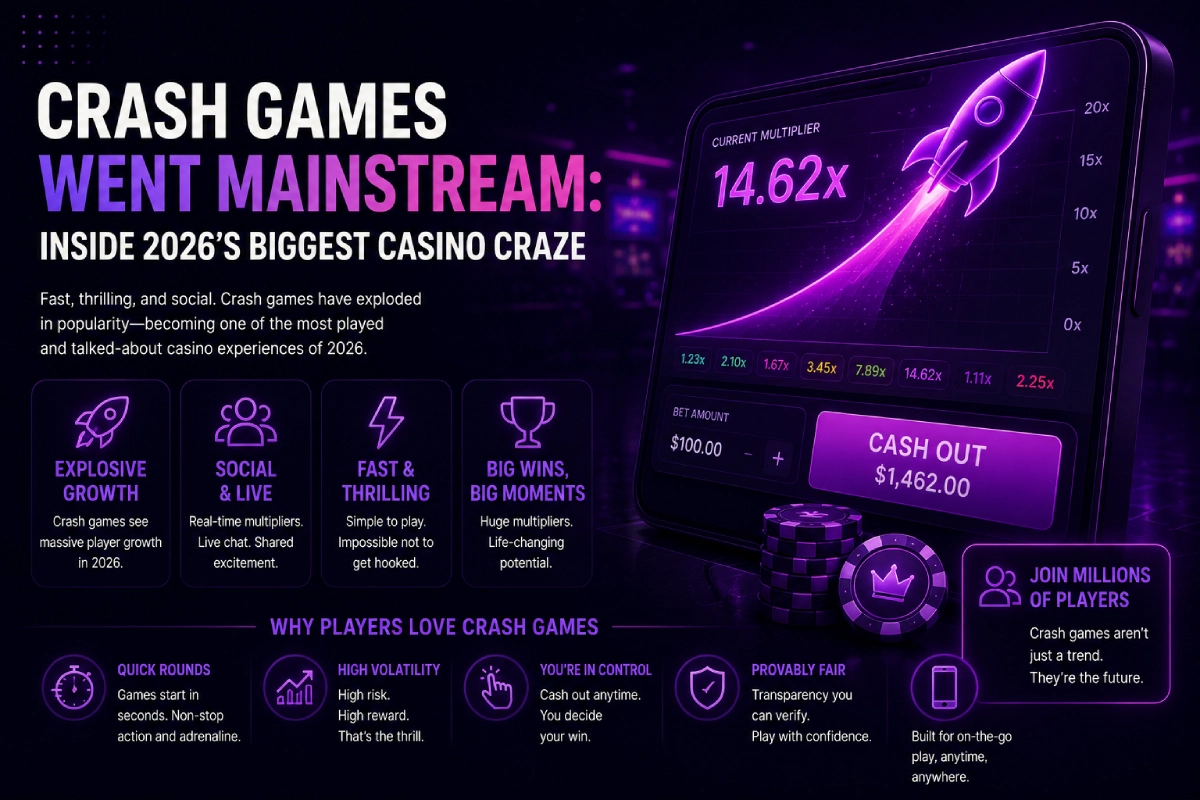
A few years ago, crash games were a crypto-casino curiosity. In 2026 they're everywhere. A rising multiplier climbs up the screen, 1.2x, 1.8x, 3x, and your job is to cash out before it "crashes." Wait too long and you lose your stake; jump too early and you leave winnings on the table. It's simple, fast, tense, and it has become one of the most-played formats online, sitting right alongside slots on the lobby of almost every modern casino.
The genre owes its breakout to Aviator-style games, where the multiplier is a little plane flying off the screen, but the mechanic now wears a dozen skins: rockets, divers, gems, race cars. Strip away the theme and they all do the same thing. Understanding that one core mechanic tells you almost everything you need to know about the whole craze.
How a crash game actually works
Each round, the game generates a "crash point," a multiplier at which the round will end. You place your bet before the round starts. The multiplier then ticks upward from 1x, and rising, and you can hit cash out at any moment to lock in your stake multiplied by the current figure. If the round crashes before you cash out, you lose the bet. That's the entire game.
The reason it feels so different from a slot is that you control the exit, not the outcome. A slot spins and shows you a result. A crash game hands you a live decision under pressure: take the safe 1.4x now, or hold your nerve for 5x and risk it all. That illusion of control is a huge part of the appeal, and, as we'll see, also where players fool themselves.
| Element | What it is | What it means for you |
|---|---|---|
| Crash point | The pre-set multiplier where the round ends | Decided before you can react; you can't influence it |
| Cash-out | Your manual (or auto) exit button | The only thing you actually control |
| Provably fair | A cryptographic way to verify the result | Lets you confirm the round wasn't altered |
| House edge | The margin built into the maths | Present in every round, whatever you do |
Provably fair, explained simply
Because crash games grew up on crypto casinos, most use a "provably fair" system, and it's genuinely worth understanding. Before a round, the game commits to a result using a cryptographic hash, a scrambled fingerprint of the outcome it can't change later. After the round, it reveals the inputs so you can run the same calculation yourself and confirm the crash point was set in advance, not rigged against you mid-flight.
That's a real transparency win over a traditional black-box game. But be clear about what it proves. Provably fair confirms the result wasn't tampered with; it does not mean the game has no house edge or that you can beat it. A fair coin is provably fair too, and the casino still wins over time because the maths is tilted its way. Fairness and profitability for the house are not in conflict.
The auto-cashout strategy myth
Every crash game lets you set an automatic cash-out, and every forum is full of "strategies" built around it: always cash out at 1.5x, chase one big 10x, use a Martingale where you double after each loss. It's worth saying plainly, none of them change your expected return. The crash point is already decided before your round begins, so no cash-out pattern can shift the underlying odds.
What these approaches actually do is change the shape of your results, not the total. Cashing out low and often gives you frequent small wins and the occasional gut-punch when a round crashes instantly. Holding for big multipliers gives you long dry spells and rare spikes. Martingale, doubling after losses, feels clever until a losing streak hits your table limit or your bankroll, which it eventually will. You can pick your risk profile; you cannot pick a winning system, because there isn't one. The house edge is baked into the crash-point distribution itself.
How we look at crash games
When we test a casino offering crash titles, we check that the game is from a recognised studio, that provably-fair verification actually works when you click it, and that the stated return-to-player is disclosed rather than hidden. A crash game can be perfectly fair and still be a fast way to lose money, so we treat it like any high-tempo format: fun in short bursts, dangerous as a strategy. If you enjoy the mechanic, our market online slots guide covers the same fairness and RTP checks for the wider game library.
Why they exploded, and the honest caveat
The rise makes sense. Crash games are mobile-perfect, a round lasts seconds, they're social when a shared round shows everyone cashing out live, and the sense of agency is intoxicating compared with passively spinning a reel. Streamers love them because the tension is visual and instant. For a casino, a game people play in rapid-fire rounds is a very effective product.
That speed is exactly the caveat. Because rounds are so short and the next one is always seconds away, crash games can burn through a bankroll far faster than a slot, and the feeling of control makes it easy to keep telling yourself the next round is the one you'll time right. Set a session limit before you start, treat any winning streak as luck rather than skill, and walk away on a timer, not on a feeling.
FAQ
Can you actually win at crash games?
You can absolutely win individual rounds, sometimes big, but there's no strategy that beats the game over time. The crash point is set before your round starts and the maths carries a house edge, so the longer you play the more the odds assert themselves. Treat wins as luck, not proof of a system.
Does auto-cashout improve my odds?
No. Auto-cashout is a convenience that fires your exit at a set multiplier so you don't have to react in real time. It changes the shape of your results, more frequent small wins or rarer big ones, but not your expected return. The odds are fixed by the crash-point distribution regardless of how you exit.
What does "provably fair" mean?
It's a system that lets you verify a round wasn't altered. The game commits to the result with a cryptographic hash beforehand and reveals the inputs afterwards, so you can recalculate and confirm the crash point was set in advance. It proves fairness, not that the game lacks a house edge, a fair game can still be profitable for the casino.
Is the Martingale double-up method safe on crash games?
No. Doubling your bet after each loss feels like it must eventually recover, but a run of quick crashes hits your bankroll or the table limit fast, and then the losses are large and real. Martingale rearranges when you lose, it doesn't stop you losing. It's one of the riskier ways to play a high-tempo game.
Why did crash games get so popular?
They're quick, mobile-friendly, visually tense and give you a sense of control that slots don't, since you choose when to cash out. Rounds last seconds and feel social when everyone plays the same one live. That combination made them a favourite with streamers and spread them from crypto casinos to the mainstream.
Are crash games riskier than slots?
Not inherently in their maths, but in practice the rapid rounds and feeling of control can make them burn through a bankroll faster, and it's easy to convince yourself the next round is the one you'll time perfectly. Set a strict session limit, and lean on a timer rather than a hunch to decide when to stop.
Play responsibly
Gambling should be fun, never a way to make money or chase losses. Fast games like crash can empty a balance quickly, so set a deposit and time limit before you start and use the cooling-off tools and self-exclusion every licensed casino provides, or read our responsible gambling guide. 18+ only.